 English
 Español
An electrical contractor in Kuwait City is specifying residual current circuit breakers for a new residential complex. The panel builder has a choice of sensitivity ratings—10mA, 30mA, or 100mA—and needs to match the right device to each circuit. Meanwhile, a workshop in Shuwaikh Industrial Area requires earth leakage protection for its power tools, but the same RCCB used in a villa may not be suitable.
Selecting the right residual current circuit breaker for Kuwait installations requires understanding the application scope, the key parameters that define RCCB performance, and the environmental conditions unique to the region. This guide provides a practical framework for RCCB selection across residential, commercial, and light industrial applications in Kuwait.
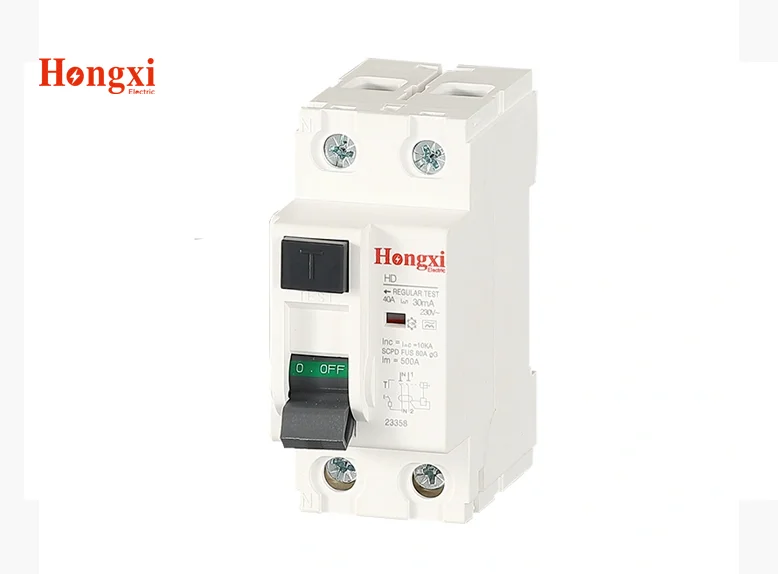
What Does an RCCB Do — And What Are Its Limitations?
An RCCB (Residual Current Circuit Breaker) is a protection device designed to detect earth leakage currents and disconnect the circuit when leakage exceeds a set threshold. It protects against electric shock and, in some cases, fire hazards caused by insulation faults.
Critical limitation: RCCBs do not provide protection against overloads or short circuits. They are earth leakage protection devices only. For complete circuit protection, RCCBs must be paired with upstream MCBs or MCCBs.
RCCBs used in Kuwait for residential, commercial, and light industrial applications typically comply with IEC 61008-1, the international standard for RCCBs for household and similar uses. This standard covers devices rated up to 125A and 440V AC, designed primarily for protection in environments where fault currents are moderate.
RCCB Product Overview — HID and HD Series
Two RCCB series commonly used in Kuwait electrical panels are the HID and HD series:
| Parameter | HID Series | HD Series |
| Standard | EN/IEC 61008-1 | IEC 61008-1 |
| Rated Current (In) | 16A – 100A | 16A – 100A |
| Poles | 2(1+N), 4(3+N) | 2(1+N), 4(3+N) |
| Sensitivity (I△n) | 10mA, 30mA, 100mA | 10mA, 30mA, 100mA |
| Rated Voltage (2P) | 230V AC | 240V AC |
| Rated Voltage (4P) | 230/400V AC | 240/415V AC |
| Inc (Short-circuit) | 6kA | 6kA |
| Trip Time @ I△n | ≤0.1s | ≤0.1s |
| Uimp | 6000V | 6000V |
| Ambient Temperature | -25℃ ~ +40℃ | — |
| Installation Width | 2P: 36mm / 4P: 72mm | 2P: 36mm / 4P: 72mm |
For detailed specifications on RCCB families compliant with IEC 61008-1, review the residual current circuit breaker series.
RCCB Applications — Where Does It Belong in Kuwait?
The standard’s scope — “household and similar uses” — provides clear guidance on where IEC 61008-1 compliant RCCBs are appropriate.
Residential Applications
RCCBs are the standard choice for villa and apartment distribution boards in Kuwait. They protect against electric shock from faulty appliances, damaged cables, or wet environments. The most common configuration is a 63A 2-pole RCCB with 30mA sensitivity serving as the main earth leakage protection for the entire dwelling, with individual MCBs protecting each final circuit.
Commercial Applications
Shops, offices, schools, and hotels in Kuwait benefit from RCCB protection on socket circuits, kitchen equipment, and other outlets where human contact is possible. Commercial installations typically use 4-pole RCCBs (63A–100A) with 30mA or 100mA sensitivity depending on the protection objective.
Light Industrial Workshops (with Conditions)
Small workshops in Shuwaikh or other industrial zones may use RCCBs for earth leakage protection, provided three conditions are met: the available fault current does not exceed the RCCB’s 6kA Inc rating, the ambient temperature stays within the rated range (-25°C to +40°C), and upstream overcurrent protection (MCB or MCCB) is installed. This makes RCCBs suitable for light assembly areas, maintenance bays, and small fabrication shops.
Heavy Industrial — Not Recommended
For heavy industrial environments (petrochemical plants, steel mills, large factories), RCCBs compliant with IEC 61008-1 are not the appropriate choice. These environments require industrial-grade protection devices compliant with IEC 60947 standards, offering higher breaking capacities, wider temperature ranges, and more robust construction.
For applications requiring comprehensive circuit protection combining earth leakage and overcurrent protection, explore residual current circuit breaker options.
Key Selection Parameters for RCCBs in Kuwait
Selecting the right RCCB requires understanding four critical parameters.
1. Sensitivity (I△n) — Choosing the Right Trip Current
| Sensitivity | Best For | Why |
| 10mA | Bathrooms, swimming pools, and medical equipment | High-risk wet environments; maximum personal protection |
| 30mA | Standard sockets, general circuits | Standard personal protection for residential and commercial installations |
| 100mA | Equipment protection, fire prevention | Industrial circuits, sensitive equipment, where nuisance tripping would be costly |
Kuwait context: 30mA is the standard for most residential and commercial circuits. 100mA is commonly used for distribution board main RCCBs, where earth leakage from multiple circuits could cause nuisance tripping at 30mA.
2. Number of Poles
-
2-pole (2P) — For single-phase circuits (live + neutral)
-
4-pole (4P) — For three-phase circuits (3 phases + neutral)
Kuwait context: Kuwait residential villas are typically single-phase, using 2-pole RCCBs. Commercial buildings and workshops with three-phase loads require 4-pole RCCBs.
3. Rated Current (In)
Select an RCCB with a rated current equal to or greater than the circuit’s maximum continuous load. For Kuwait applications:
-
Lighting circuits: 16A – 25A
-
Socket circuits: 25A – 40A
-
Small commercial distribution: 40A – 63A
-
Main incoming (villa): 63A – 100A
4. Short-Circuit Withstand Capacity (Inc)
RCCBs are rated for a specific conditional short-circuit current (Inc). The HID and HD series offer 6kA Inc, meaning they can safely withstand a fault current of up to 6,000A when protected by an upstream device. If the available fault current at the installation point exceeds 6kA, alternative protection strategies or industrial-grade devices are required.
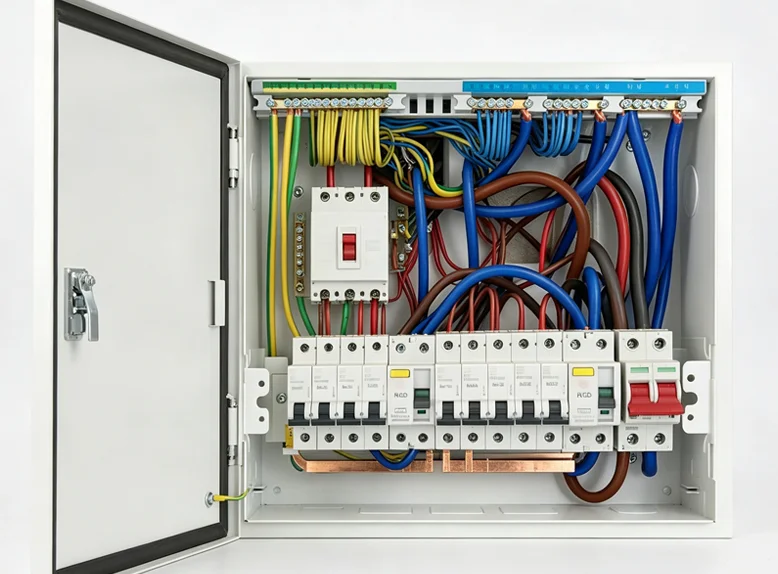
4 Steps to Select the Right RCCB for Kuwait Applications
Step 1: Identify the Application Type
-
Residential villa/apartment → 2-pole, 30mA sensitivity, 40A–63A rated current
-
Commercial building → 4-pole, 30mA or 100mA sensitivity, 63A–100A rated current
-
Light industrial workshop → 4-pole, 30mA or 100mA sensitivity, 63A–100A rated current (with upstream overcurrent protection)
-
Heavy industrial → Industrial-grade device required (IEC 60947)
Step 2: Determine Required Sensitivity
-
10mA — Wet areas, high-risk environments
-
30mA — Standard personal protection (default for most applications)
-
100mA — Equipment protection/fire prevention
Step 3: Verify Inc (Short-Circuit Withstand)
-
If fault current ≤ 6kA → Standard RCCB is suitable
-
If fault current > 6kA → Industrial-grade device required
Step 4: Check Environmental Compatibility
Kuwait’s extreme summer temperatures require attention to derating. The HID series is rated for -25°C to +40°C ambient. For installations where temperatures exceed 40°C, derating factors must be applied — or industrial-grade devices with higher temperature ratings should be selected.
Real-World Application Examples — Kuwait Installations
Example 1: Residential Villa in Salmiya
-
Application: Main distribution board for a 3-bedroom villa
-
Configuration: 63A, 2-pole, 30mA sensitivity RCCB
-
Selection Rationale: Standard residential application, 30mA for personal protection
Example 2: Office Building in Kuwait City
-
Application: Distribution board for a commercial office building
-
Configuration: 100A, 4-pole, 30mA sensitivity RCCB
-
Selection Rationale: Commercial use within standard scope, 30mA for personal protection on socket circuits
Example 3: Small Workshop in Shuwaikh Industrial Area
-
Application: Light assembly workshop with small power tools
-
Configuration: 80A, 4-pole, 30mA sensitivity RCCB + upstream 80A MCB for overcurrent protection
-
Selection Rationale: Light industrial use, fault current below 6kA, suitable for “similar uses” scope
Next Steps — From Selection Criteria to Component Specification
You now have a practical framework for selecting RCCBs for Kuwait electrical installations. The key takeaways are:
-
RCCBs provide earth leakage protection only — they must be paired with upstream overcurrent protection devices
-
IEC 61008-1 applies to RCCBs for household and similar uses — residential, commercial, and light industrial applications
-
Key selection parameters: sensitivity (10/30/100mA), number of poles (2P/4P), rated current (16–100A), and short-circuit withstand (6kA for HID/HD series)
-
Kuwait’s extreme ambient temperatures may require derating — verify that devices are rated for the installation environment
Once you have determined your application type, required sensitivity, current rating, and fault current conditions, comparing the specific technical specifications of available RCCB families becomes the logical next step.
After establishing your electrical installation’s RCCB requirements — application type, sensitivity, current rating, and fault current conditions — you can review the technical specifications of HID and HD series RCCBs for residential, commercial, and light industrial applications in Kuwait.
Related Reading
-
How Ambient Temperature Affects Circuit Breaker Performance
-
Industrial Workshop MCCB Matching Supply Case Manufacturer Kuwait