 English
 Español
A distribution panel is being designed for a new industrial facility. The engineer specifies a 63A miniature circuit breaker for the main incoming supply—it fits the budget and occupies minimal space. Six months later, a fault downstream causes the breaker to weld its contacts shut, taking down the entire panel and halting production for two days.
The problem was not a faulty breaker. It was a fundamental mismatch between the device’s design capacity and the demands of a main panel application. While both MCBs and MCCBs protect circuits from overloads and short circuits, they are engineered for entirely different scales of operation.
This guide explains the critical differences and provides a practical framework for choosing the right device for your main distribution panel.
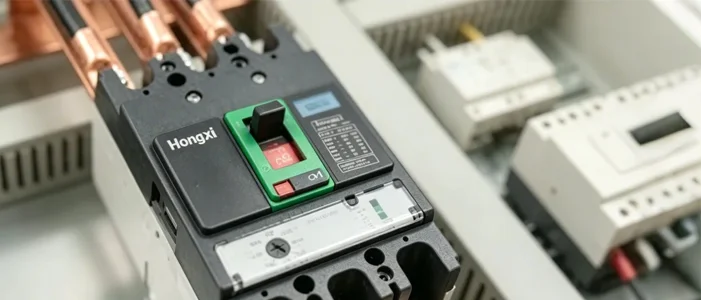
The Core Difference — Capacity and Flexibility
At first glance, MCBs and MCCBs appear similar: both are low-voltage circuit breakers that provide overload and short-circuit protection. But their engineering design targets entirely different scales of operation.
| Parameter | MCB (Miniature Circuit Breaker) | MCCB (Molded Case Circuit Breaker) |
| Current Rating | Typically 0.5A to 125A | Typically 15A to 2500A or more |
| Breaking Capacity (ICU) | Up to 10kA–15kA | 10kA to 200kA |
| Voltage Rating | Typically up to 440V AC | Up to 690V AC or 1000V AC |
| Physical Size | Compact (~17.5mm per pole) | Larger frame size varies by rating |
| Trip Settings | Fixed, non-adjustable | Often adjustable |
| Poles Available | 1P, 2P, 3P, 4P | Typically 3P, 4P |
| Applicable Standard | IEC 60898-1 | IEC 60947-2 |
| Cost | Lower | Higher |
Why this matters for main panel protection: The main incoming breaker must handle the entire facility’s load and fault current. If the available short-circuit current at the panel exceeds the breaker’s interrupting capacity, the breaker may fail catastrophically—welding contacts, releasing ionized gas, and damaging adjacent equipment.
For detailed specifications on miniature circuit breakers suitable for sub-distribution and branch protection, review the HX series MCB family.
Understanding the Standards — IEC 60898-1 vs IEC 60947-2
The standards that govern MCBs and MCCBs reveal their intended applications.
IEC 60898-1 applies to MCBs for household and similar installations. It covers devices with:
-
Rated voltage not exceeding 440V AC (between phases)
-
Rated current not exceeding 125A
-
Rated short-circuit capacity not exceeding 25,000A
-
Intended for operation by ordinary persons (non-skilled users)
IEC 60947-2 applies to circuit breakers for industrial applications. It covers:
-
Rated voltage up to 1000V AC or 1500V DC
-
Rated currents from a few amps to 6300A and higher
-
Intended for installation and operation by skilled persons
-
Broader scope, including MCCBs and ACBs
The practical implication is straightforward: MCBs are designed for final circuits in residential, commercial, and light industrial settings, while MCCBs are designed for main distribution and heavy industrial applications. Some MCBs may also comply with IEC 60947-2, but their short-circuit breaking capacity under that standard is often higher than under IEC 60898-1.
When to Use an MCB for Main Panel Protection
Despite their limitations, MCBs can be appropriate for main panel protection in specific, lower-demand scenarios.
An MCB is a viable choice for the main incoming position when:
-
Total panel load is 63A or less — MCBs are typically rated up to 63A or 125A
-
Available short-circuit current is 10kA or less
-
Space is constrained — MCBs occupy minimal panel space
-
Cost is a primary concern — MCBs cost considerably less than MCCBs
-
Fixed trip settings are acceptable — no need for adjustable protection
-
The application is residential or small commercial
The “sweet spot” for MCBs:
-
Current rating of 63A or less
-
SCCR of 10kA or less
-
Fixed trip curves
For applications requiring both circuit protection and motor-specific features, motor protection circuit breakers offer adjustable overload protection for dedicated motor circuits.
When an MCCB Is the Mandatory Choice
For most industrial main panels, MCCBs are not optional—they are a requirement.
MCCBs are mandatory for main panel protection when:
-
Total load exceeds 100A — MCCBs handle currents from 15A to 2500A
-
Available fault current exceeds 10kA — MCCBs provide interrupting capacity up to 200kA
-
Adjustable trip settings are needed to accommodate motor inrush currents or coordination requirements
-
Selective coordination is required — MCCBs allow time-delay settings to ensure only the faulted circuit trips
-
The panel serves industrial machinery, large motors, or transformers
-
System voltage exceeds 440V
A key distinction is ICS vs. Icu: Icu is the ultimate breaking capacity (the breaker can interrupt a fault once and must be replaced afterward). ICS is the service breaking capacity (the breaker can interrupt a fault and remain operational). For continuous industrial operations, ICS is crucial. MCCBs typically offer Ics = 100% Icu, meaning they can be reused after a fault—saving replacement costs.
5 Steps to Choose Between MCB and MCCB for Your Main Panel
Follow this practical decision framework when specifying the main breaker for a distribution panel.
Step 1: Calculate Your Total Connected Load
Sum the expected continuous load of all downstream circuits. Include a safety margin (typically 20–25%). If the total exceeds 100A, an MCB is likely insufficient. If it is 63A or less, an MCB may be suitable—but continue to Step 2.
Step 2: Determine Available Short-Circuit Current
Calculate the prospective short-circuit current at the main panel terminals, considering transformer kVA, impedance, and cable lengths. If the value exceeds 10kA, an MCB is not suitable. MCCBs provide the necessary interrupting capacity.
Step 3: Evaluate Adjustability Requirements
-
If you need to fine-tune trip settings for motor inrush, coordination, or changing loads → MCCB
-
If fixed trip settings are acceptable → MCB may suffice
Step 4: Consider Physical Space and Budget
-
MCBs are compact and cost-effective
-
MCCBs are larger and more expensive
-
Never parallel MCBs to handle higher currents—tripping synchronization cannot be guaranteed
Step 5: Verify Standard Compliance
-
For residential/small commercial main panels → IEC 60898-1 MCBs may be acceptable
-
For industrial main panels → IEC 60947-2 MCCBs are required
Real-World Application Examples
Example 1: Small Retail Store Main Panel
-
Load: 40A total (lighting, receptacles, small HVAC)
-
Fault current: 6kA (calculated)
-
Space: Limited panel enclosure
-
Decision: MCB (63A, 10kA) is appropriate — cost-effective, compact, and within rating
Example 2: Industrial Manufacturing Facility Main Panel
-
Load: 400A total (multiple motors, welding equipment, conveyors)
-
Fault current: 25kA (near transformer)
-
Requirements: Adjustable trip settings for motor inrush; selective coordination with downstream breakers
-
Decision: MCCB (400A frame, 50kA interrupting capacity) is mandatory
Example 3: Commercial Building Main Panel with Mixed Use
-
Load: 200A total (lighting, elevators, HVAC, office equipment)
-
Fault current: 15kA
-
Consideration: Future expansion expected
-
Decision: MCCB with adjustable trip settings provides flexibility for future load changes and ensures adequate fault protection
Common Selection Mistakes to Avoid
| Mistake | Why It Fails | Better Approach |
| Using an MCB for a main panel with >63A load | MCB contacts cannot handle sustained high currents | Specify MCCB with appropriate frame size |
| Ignoring available fault current | MCB may weld shut during a fault | Calculate fault current; select breaker with adequate Icu |
| Paralleling MCBs to handle higher currents | Tripping synchronization cannot be guaranteed | Use a single MCCB of the correct rating |
| Selecting based on price alone | Inadequate protection leads to costly downtime | Evaluate total cost of ownership, not just upfront price |
| Assuming MCBs and MCCBs are interchangeable | Different designs, capacities, and standards | Match device type to application requirements |
Next Steps — From Selection Criteria to Component Specification
You now have a practical framework for deciding between MCB and MCCB for main panel protection. The key takeaways are:
-
MCBs are suitable for main panels with ≤63A load, ≤10kA fault current, and fixed trip requirements
-
MCCBs are mandatory for main panels with >100A load, >10kA fault current, or adjustable protection needs
-
The governing standards (IEC 60898-1 for MCBs, IEC 60947-2 for MCCBs) reflect fundamentally different intended applications
-
Never compromise on breaking capacity—it is a safety-critical parameter
Once you have determined your panel’s load, fault current, and adjustability requirements, comparing the specific technical specifications of available devices becomes the logical next step.
After establishing your main panel protection requirements (load current, fault level, and need for adjustability), you can review the technical specifications of HX series MCBs for lower-demand applications, or explore HM series MCCBs for industrial main panels requiring higher capacity and adjustable trip settings.
Related Reading
-
Contactor vs MCB for Motor Control Applications
-
Reduce Replacement Frequency with High-Endurance MCB
-
Short-Circuit Current Rating (SCCR) for Electrical Panels