 English
 Español
A procurement manager for a large infrastructure project in the Middle East receives quotations from seven different MCCB suppliers. Prices vary by nearly 40%. All claim to be “ISO certified” and “IEC compliant.” Yet, six months after installation, breakers from the lowest-cost supplier begin tripping intermittently—not because they are faulty, but because they were never designed for the project’s 50°C ambient conditions.
Selecting a moulded case circuit breaker (MCCB) manufacturer for an industrial project is not a price-driven decision. It is a technical evaluation that determines the safety, reliability, and longevity of an entire power distribution system.
This guide provides a practical framework for evaluating MCCB manufacturers—covering certifications, factory capability, material quality, temperature derating, and testing transparency—to help procurement professionals and project engineers make informed sourcing decisions.
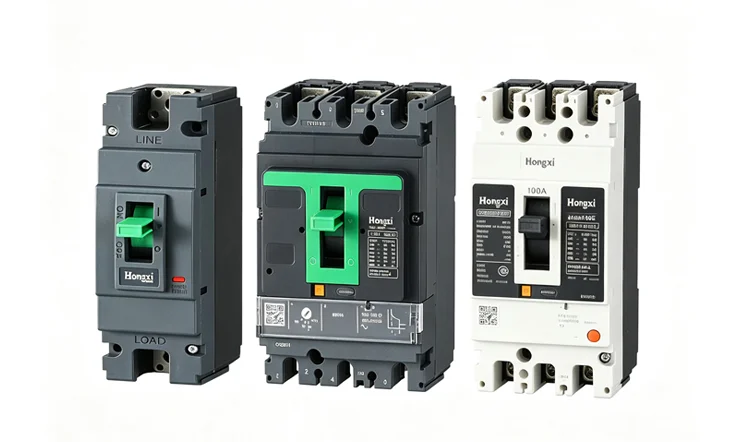
Understanding MCCBs and Their Role in Industrial Projects
Before evaluating manufacturers, it helps to understand what MCCBs are and where they fit in industrial power systems.
An MCCB (Moulded Case Circuit Breaker) is a low-voltage circuit protection device designed for industrial and commercial applications. Unlike miniature circuit breakers (MCBs), which protect final circuits in residential settings, MCCBs offer:
-
Higher current ratings — typically from 16A up to 1,600A and beyond
-
Stronger breaking capacities — from 10kA to over 100kA at 415V
-
Adjustable trip characteristics — allowing coordination with downstream devices
-
Quick reset capability — after tripping, without replacing components
In industrial projects, MCCBs are deployed in main distribution cabinets, sub-distribution cabinets, and busbar trunking protection. They protect large motors, transformers, feeders, and critical equipment in manufacturing plants, data centers, and infrastructure projects.
The standard that governs MCCB performance for industrial applications is IEC 60947-2. This standard applies to circuit breakers intended for installation and operation by skilled persons, with rated voltages up to 1,000V AC or 1,500V DC. Unlike IEC 60898 (which covers residential MCBs), IEC 60947-2 addresses the higher fault currents and more demanding operating conditions found in industrial environments.
The practical implication: If a manufacturer claims to supply “industrial MCCBs” but only references IEC 60898 certification, that is a red flag. Industrial projects require IEC 60947-2 compliance.
For detailed specifications on MCCB families designed to meet IEC 60947-2 standards for industrial applications, review the HM series moulded case circuit breaker technical overview.
The Manufacturer Evaluation Framework — 6 Key Criteria
Selecting an MCCB manufacturer for industrial projects requires a systematic evaluation across six dimensions. Do not rely on price alone; adopt a holistic framework that balances technical capability, quality assurance, and service responsiveness.
1. Standards Compliance and Certifications
This is the first filter when evaluating any MCCB supplier. A qualified MCCB for industrial projects must meet internationally recognized requirements.
| Certification/Standard | Why It Matters |
|---|---|
| IEC 60947-2 | The core standard for industrial MCCBs. Do not accept residential (IEC 60898) standards for industrial applications. |
| ISO 9001:2015 | Ensures the factory has a consistent Quality Management System (QMS). |
| CE / CB / KEMA | Third-party validation that the breaker can safely interrupt high fault currents (Icu). |
| RoHS | Ensures materials are free from hazardous substances. |
| UL 489 (for North America) or CSA (for Canada) | Required for projects in specific regions. |
Critical check: Do not rely only on a certificate image. Ask for test reports or verification documents. Low-quality products often copy certificate numbers without passing actual tests.
Regional note: For projects in the Gulf Cooperation Council (GCC) region, GSO standards based on IEC apply. For Saudi Arabia specifically, SASO IECEE certification is mandatory—verify that the manufacturer can provide this documentation.
2. Factory Capability and Production Capacity
A trading company may offer low prices, but a real manufacturer provides better control over design, production, quality inspection, and delivery schedules.
What to evaluate:
-
Operational history: Suppliers with at least 5 years of continuous operation typically demonstrate resilience and experience managing international orders.
-
Physical infrastructure: Factories exceeding 10,000 m² with 200+ employees are better equipped to handle large-volume or custom orders.
-
Production lines: Automated or semi-automated assembly lines indicate stable production processes.
-
In-house capabilities: Mold-making, R&D teams, and testing labs signal long-term innovation capability.
Why this matters for industrial projects: Industrial projects often require specific frame sizes, breaking capacities, and trip settings. A manufacturer with limited production capability may not be able to deliver consistent quality at scale or accommodate customization requests.
3. Material Quality — The “Hidden” Difference
The difference between a $15 MCCB and a $40 MCCB often lies in the materials you cannot see without opening the unit.
Contact materials (silver alloy): Contacts are the heart of the breaker.
-
High quality: 85% Silver-Tungsten (AgW) or Silver-Graphite (AgC) — these withstand arcs and prevent welding.
-
Low quality: Copper coated with thin silver — welds during fault interruption.
Housing materials:
-
High-quality MCCBs use flame-retardant, high-temperature-resistant thermoset plastics
-
Low-quality alternatives may use recycled materials that degrade under heat
For procurement professionals: Ask the manufacturer what contact materials they use. A reputable manufacturer will provide this information transparently. If they cannot or will not, consider it a red flag.
4. Temperature Derating Data — Non-Negotiable for Hot Climates
MCCB rated current is typically tested at 40°C ambient temperature. Inside real distribution panels—especially in the Middle East, South Asia, or Africa—temperatures often exceed 50–55°C.
What this means: Without derating data, a 250A MCCB might safely carry far less current in your actual installation, leading to nuisance tripping that appears “unexplainable.”
What to request from the manufacturer:
-
Derating curves showing current-carrying capacity at different ambient temperatures
-
Maximum operating temperature rating (ideally 60°C or higher for electronic trip units)
-
Verification that the device has been tested at elevated temperatures
For projects in the GCC region: This is particularly critical. Kuwait, Saudi Arabia, and the UAE frequently experience ambient temperatures exceeding 50°C. Manufacturers that cannot provide derating data should not be shortlisted.
5. Breaking Capacity — Icu and Ics
Breaking capacity is frequently ignored during purchasing, yet it is one of the most critical parameters.
| Term | Meaning | Why It Matters |
|---|---|---|
| Icu (Ultimate Breaking Capacity) | Maximum fault current the breaker can interrupt once, without damage | If your system fault level is 25kA and the MCCB is rated for 18kA, the breaker may fail catastrophically during a short circuit |
| Ics (Service Breaking Capacity) | Fault current the breaker can interrupt and remain operational | For continuous industrial operations, Ics is crucial—it means the breaker can be reused after a fault |
What to verify:
-
Ask the supplier for breaking capacity data
-
Match Icu and Ics to your electrical system’s calculated fault current
-
Ensure the manufacturer provides test certificates from recognized bodies (ASTA, ASEFA, KEMA, etc.)
6. Trip Unit and Adjustability
Modern MCCBs use either thermal-magnetic or electronic trip units. The difference greatly affects protection accuracy and coordination.
| Trip Unit Type | Best For | Key Consideration |
|---|---|---|
| Thermal-magnetic | Smaller MCCBs, simpler applications | Fixed or limited adjustability |
| Electronic | Larger MCCBs (>250A), complex industrial networks | Adjustable long-time delay, short-time delay, instantaneous trip, ground fault protection |
For industrial projects: Fixed trip curves are cheaper but make proper system coordination almost impossible, especially in multi-level distribution systems. If your project requires selective coordination with downstream breakers, electronic trip units with adjustable settings are essential.
For applications requiring selective coordination and adjustable protection settings in complex industrial networks, explore MCCB options with electronic trip units.
5 Steps to Select an MCCB Manufacturer for Your Industrial Project
Follow this practical framework when sourcing MCCBs for industrial projects.
Step 1: Define Your Technical Requirements
Before contacting any supplier, define the application clearly. Many problems begin because buyers ask for a price without explaining where and how the MCCB will be used.
Questions to answer:
-
What is the total connected load?
-
What is the prospective short-circuit current at the installation point?
-
Is the system single-phase or three-phase?
-
Will the breaker operate inside a high-temperature panel?
-
Is selective coordination with upstream or downstream breakers required?
-
Are adjustable trip settings necessary?
Step 2: Shortlist 3–5 Manufacturers
Prioritize suppliers with documented compliance, responsive service, and verifiable track records.
Where to look:
-
China remains the world’s largest producer of low-voltage electrical components. Within China, Zhejiang Province — particularly cities like Wenzhou and Yueqing — is the epicenter of MCCB manufacturing.
-
These regions host vertically integrated factories that produce everything from MCBs to MCCBs. Proximity to testing labs accredited under IEC, CB Scheme, and UL standards accelerates certification processes.
Step 3: Request and Review Technical Documentation
| Document to Request | What to Look For |
|---|---|
| IEC 60947-2 test reports | Verifiable breaking capacity (Icu/Ics), dielectric strength, thermal stability |
| Derating curves | Current-carrying capacity at elevated ambient temperatures |
| Trip curve accuracy data | Verify against declared ratings |
| Routine test reports | Should be available for each unit at the time of inspection |
| Material certificates | Contact material composition, housing material flame-retardant rating |
Step 4: Request Physical Samples
Always request physical or digital samples before committing to bulk orders. Use this phase to assess:
-
Build quality and housing material
-
Labeling clarity and durability
-
Mechanical fit and terminal strength
-
Operating mechanism feel — poor external quality often reflects weak internal components
For first-time transactions: Use secure payment methods such as trade assurance or escrow services. Conduct independent lab tests to verify mechanical endurance (minimum 10,000 operations) and pole synchronization.
Step 5: Evaluate Operational Performance Metrics
Beyond technical specifications, assess the manufacturer’s operational reliability:
| Metric | Target | Why It Matters |
|---|---|---|
| On-time delivery rate | ≥ 90% | Delays cost money on industrial projects |
| Customer reorder rate | > 20% | Indicates satisfaction and product reliability |
| Average response time | Within hours, not days | Technical support matters during installation and troubleshooting |
Real-World Application Examples
Example 1: Manufacturing Facility in Saudi Arabia
-
Requirement: 400A main incoming, 25kA fault current, 50°C ambient
-
Selection criteria: IEC 60947-2 compliance, 50kA Icu, electronic trip unit, derating data for 50°C
-
Outcome: Manufacturer with full test documentation and temperature derating curves selected. Panel operates without nuisance tripping through summer months.
Example 2: Data Center in UAE
-
Requirement: 630A feeders, high continuity of service, selective coordination required
-
Selection criteria: IEC 60947-2, Ics = 100% Icu, electronic trip with adjustable settings, Type-2 coordination per IEC 60947-4
-
Outcome: Manufacturer with KEMA-certified test reports and proven track record in similar projects selected.
Example 3: Infrastructure Project in Kuwait
-
Requirement: 250A sub-distribution, 18kA fault current, 55°C switchroom temperature
-
Selection criteria: IEC 60947-2, 25kA Icu, thermal-magnetic trip with derating applied, GSO-compliant certification
-
Outcome: Manufacturer providing verified derating curves and SASO/GSO documentation selected.
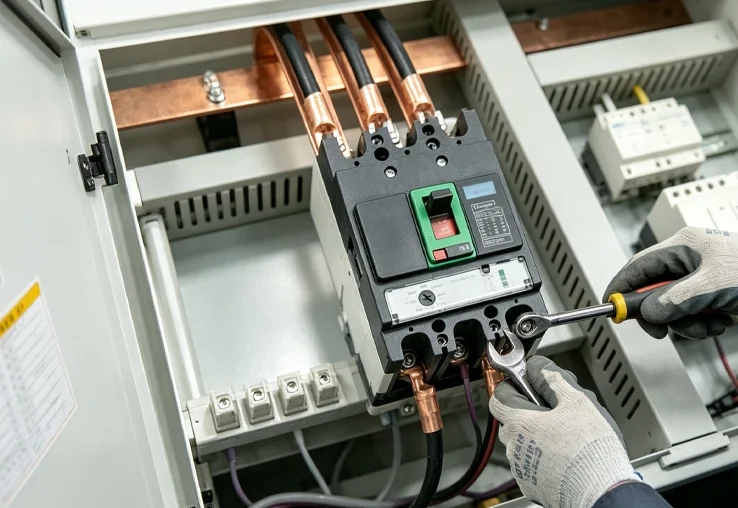
Next Steps — From Manufacturer Selection to Component Specification
You now have a practical framework for evaluating and selecting MCCB manufacturers for industrial projects. The key takeaways are:
-
IEC 60947-2 compliance is non-negotiable for industrial MCCBs — do not accept residential standards (IEC 60898)
-
Certifications must be verifiable — request test reports, not just certificate images
-
Material quality (especially contact silver alloy) determines long-term reliability
-
Temperature derating data is essential for projects in hot climates — without it, nuisance tripping is almost guaranteed
-
Breaking capacity (Icu/Ics) must exceed the available fault current at the installation point
-
Trip unit adjustability (thermal-magnetic vs electronic) affects coordination capability
-
Factory visits and sample testing are the best ways to verify manufacturer claims
Once you have identified shortlisted manufacturers that meet your technical requirements, comparing their specific product specifications, pricing, and lead times becomes the logical next step.
After establishing your industrial project’s MCCB requirements — frame size, breaking capacity, trip unit type, temperature rating, and certification needs — you can review the technical specifications of HM series MCCBs for main distribution applications, or explore MCB options for smaller branch circuits where MCCBs are not required.
Related Reading
-
MCCB Frame Size Selection for Industrial Distribution Panels
-
Understanding MCCB Trip Units: Thermal-Magnetic vs Electronic
-
How to Verify MCCB Test Reports and Certificates
-
MCCB Procurement Checklist for International Projects
-
Factory Audit Guide for Low Voltage Electrical Manufacturers