 English
 Español
When you're designing or upgrading an industrial control panel, one of the first decisions you'll face is whether to use an AC coil or a DC coil contactor. The choice isn't just about what's available on the shelf—it directly affects how your system performs, how quietly it runs, how easily it integrates with your PLC, and even how much energy it consumes over time.
This guide breaks down the technical differences between AC and DC coil contactors in plain language, explains what each choice means for your daily operations, and gives you a clear framework for making the right decision for your specific application. For a comprehensive overview of available options, explore the AC Contactor series from Hongxi Electric.
What Actually Happens Inside the Coil?
Before comparing options, it helps to understand what the coil does. The coil is the "heart" of a contactor—when energized, it creates a magnetic field that pulls the contacts together, allowing power to flow to your motor, heater, or other load.
AC coil contactors are powered by alternating current. Because AC voltage cycles polarity and magnitude, the magnetic field it produces fluctuates—crossing zero 100 or 120 times per second depending on your regional frequency. This fluctuation causes the core to vibrate, which is why AC contactors produce that characteristic humming sound. To reduce this vibration, manufacturers add a shading ring (also called a short-circuit ring) to the core.
DC coil contactors, on the other hand, run on direct current. The current flows in one direction at a constant level, producing a steady, non-fluctuating magnetic field. No shading ring is needed, and the result is silent, smooth operation with less mechanical vibration.
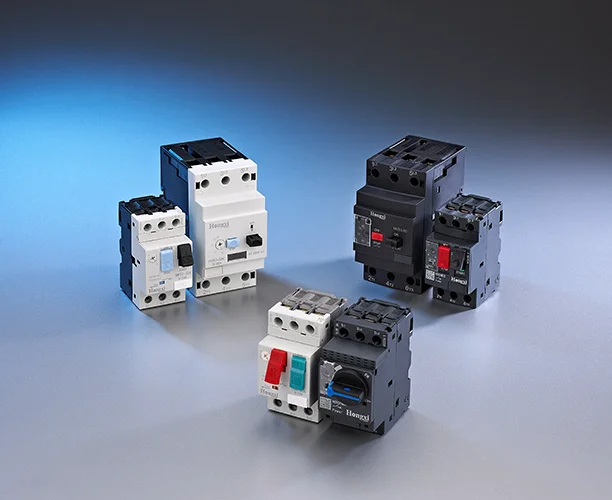
This fundamental difference in how the coil operates ripples through every other aspect of performance—from wiring complexity to automation compatibility to long-term maintenance. When selecting a contactor, it's also worth considering how it will work alongside other protection devices in your panel, such as the Motor Protection Circuit Breaker for comprehensive motor control.
AC Coil vs. DC Coil — Side-by-Side Comparison
| Feature | AC Coil Contactor | DC Coil Contactor |
|---|---|---|
| Control Power Type | Alternating Current (AC) | Direct Current (DC) |
| Common Voltages | 24V, 110V, 230V, 415V AC | 12V, 24V, 48V, 110V DC |
| Magnetic Field | Fluctuating, crosses zero 100-120x/sec | Steady, constant |
| Noise Level | Audible humming; increases as shading ring ages | Silent operation |
| Core Construction | Laminated silicon steel to reduce eddy currents | Solid mild steel |
| Shading Ring | Required to reduce chatter | Not required |
| Coil Design | Fewer turns, thicker wire, higher current | More turns, slender wire |
| Inrush Current | High inrush (6:1 to 10:1 ratio) | No inrush; constant current |
| Arc Suppression | Relies on AC zero-crossing + arc chute | Requires magnetic blowout, wider gap |
| Automation Compatibility | Limited; not ideal for direct PLC control | Directly compatible with PLCs, IPCs |
| Wiring Complexity | Simple; no polarity concerns | Polarity-sensitive; requires snubbers/diodes |
| Relative Cost | Lower | Higher |
Five Key Factors to Guide Your Decision
Choosing between AC and DC coil contactors comes down to answering five practical questions about your system:
1. What control voltage is already available in your panel?
This is the most straightforward factor. If your control circuit already distributes AC voltage (say, 230V AC from a control transformer), an AC coil contactor fits without any additional conversion. If your panel runs on 24V DC (common in modern PLC-based systems), a DC coil is the natural choice. Matching coil voltage to your existing control power avoids adding rectifiers or transformers.
2. How important is silent operation?
If your equipment operates in noise-sensitive environments—offices, hospitals, residential buildings, or quiet production areas—the silent operation of DC coils is a clear advantage. AC coils produce audible hum that can become more pronounced as the shading ring wears over time.
3. Does your system use PLC or automation controls?
DC coil contactors are the automation-friendly choice. They can be driven directly by PLCs, industrial controllers, and relay output modules without the need for AC/DC conversion. AC coils, by contrast, are less compatible with direct digital control and may require additional interface components.
4. What is your expected switching frequency?
If your application requires frequent switching—such as in high-cycle automation or robotics—DC contactors have a significant advantage. DC contactors can operate at frequencies up to 2,000 times per hour, compared to around 600 times per hour for AC contactors.
5. What are your energy efficiency priorities?
DC coils typically consume less energy during the hold-in state because they draw constant, low current. AC coils have higher inrush current on pull-in and can create momentary voltage drops. Research published in IEEE Xplore has shown that advanced DC coil control designs can achieve energy savings of over 43% compared with traditional coil direct control methods.
Common Application Scenarios
Scenario A: Traditional Industrial Motor Control
A manufacturing plant running three-phase induction motors from a standard AC control panel. The control voltage is 230V AC from a transformer, and operators use push buttons for start/stop. AC coil contactors are the economical, straightforward choice—they match the existing AC control architecture, require minimal wiring complexity, and are widely available.
Scenario B: PLC-Controlled Automation Line
A modern automated assembly line where a PLC sends 24V DC control signals to dozens of contactors. The system runs continuously with frequent switching cycles. DC coil contactors are the clear winner—they integrate directly with the PLC outputs, operate silently, handle high switching frequencies, and eliminate the need for AC/DC conversion modules.
Scenario C: Solar PV System
A solar power installation where the control system runs on battery-backed 24V DC. DC coil contactors are the natural fit for this environment—they match the DC control voltage, operate reliably in renewable energy applications, and avoid the complexity of converting DC to AC for coil control.For applications requiring flexible control voltage options, some manufacturers offer AC/DC-operated contactors that can accept either AC or DC coil voltages across a wide range (e.g., 24–500V AC or 20–500V DC), reducing inventory complexity.
Next Steps — From Guide to Selection
Once you've clarified these key decision factors—your available control voltage, noise requirements, automation needs, switching frequency, and energy priorities—comparing the specific specifications of available options becomes the next logical step.
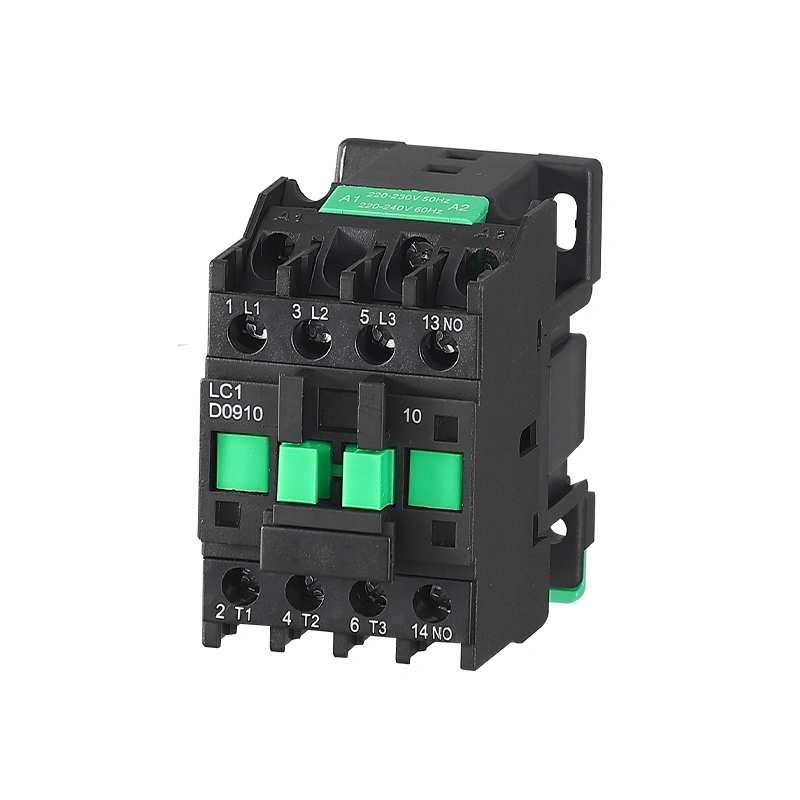
You can review Hongxi Electric's HC1 Series AC contactors for standard industrial motor control applications, or explore the HC2 Series for DC-coil-compatible designs that integrate seamlessly with modern automation systems. For applications requiring higher current ratings, the HC2-F Series heavy-duty contactors offer ratings up to 630A.
To better understand how contactors fit into a complete protection strategy, you may also find it useful to compare different types of circuit breakers. See our guide: MCB vs MCCB: Which Protection Device Fits Your Panel?For a deeper dive into contactor sizing and utilization categories (AC-1, AC-3, DC-1, etc.), see our related guide: Understanding Contactor Utilization Categories for Motor Control.
Related Reading
-
Designing Reliable Circuit Protection for Industrial Power Distribution
-
Electrical Protection Challenges in Factory Automation Systems
-
Why Buyers from 5 Continents Choose Hongxi Electric for MCB, RCCB, and Contactor Supply
-
MCB VS MCCB: Which Protection Device Fits Saudi Industrial Factories Supplier
-
Building a Reliable Motor Control Panel: Component Selection Guide