 English
 Español
A factory in Dammam's industrial city installs a new production line. The panel builder specifies 63A miniature circuit breakers for the main incoming supply—they are cost-effective and readily available. Three months into operation, during the peak of summer when ambient temperatures inside the electrical room reach 55°C, the main breaker trips repeatedly. Production stops. The culprit is not a faulty device—it is a fundamental mismatch between the breaker's design limits and the demands of a Saudi industrial environment.
Saudi Arabia's industrial sector operates under unique conditions: extreme desert heat, a 60Hz power frequency, and stringent Saudi Standards, Metrology and Quality Organization (SASO), and Saudi Electricity Company (SEC) requirements. Understanding the difference between MCBs and MCCBs—and knowing which one belongs where—is essential for any electrical distributor, panel builder, or factory maintenance engineer operating in the Kingdom.
The Regulatory Landscape — What Standards Apply in Saudi Arabia?
Before comparing devices, it is essential to understand the standards that govern their use in Saudi Arabia.
SASO and IEC Equivalence
Saudi Arabia has adopted IEC standards through the SASO IECEE certification scheme. Since November 2021, circuit breakers entering the Saudi market have been required to hold a SAU IECEE certificate. The applicable standards are:
| Device Type | Applicable Standard |
| MCBs (domestic/residential) | SASO GSO IEC 60898-1 |
| MCBs (DC applications) | SASO IEC 60898-2 / IEC 60898-3 |
| MCCBs (industrial main distribution) | SASO IEC 60947-2 |
Industrial vs Domestic Circuit Breakers
The distinction between IEC 60898-1 and IEC 60947-2 is not merely academic—it defines the entire design philosophy of each device.
IEC 60898-1 (MCBs) applies to circuit breakers for household and similar installations:
-
Rated voltage not exceeding 440V (between phases)
-
Rated current not exceeding 125A
-
Rated short-circuit capacity not exceeding 25kA
-
Designed for unskilled users
-
Found in residential homes, shops, schools, and office distribution boards
IEC 60947-2 (MCCBs) applies to industrial circuit breakers:
-
Rated voltage up to 1000V AC or 1500V DC
-
Rated current from 0.5A to 6300A
-
Designed for skilled users
-
Found in commercial buildings, industrial facilities, main distribution switchboards, and motor control centers
SEC Requirements for Industrial Panels
For industrial facilities connected to the Saudi Electricity Company grid, SEC specifications often mandate specific requirements. SEC Distribution Material Specification 31-SDMS-07C, for example, specifies minimum technical requirements for low voltage distribution panels—and explicitly references outgoing MCCBs for main distribution. For circuit breakers of 630A and above, industry-recognized practical limits on the number of breakers per panel apply.
For any supplier exporting to Saudi Arabia, compliance with SASO regulations and the SABER platform is mandatory.
For detailed specifications on circuit breakers designed to meet international standards, including IEC 60898 and IEC 60947, review the HX series MCB and HM series MCCB technical overview.
MCB vs MCCB — The Core Differences for Industrial Applications
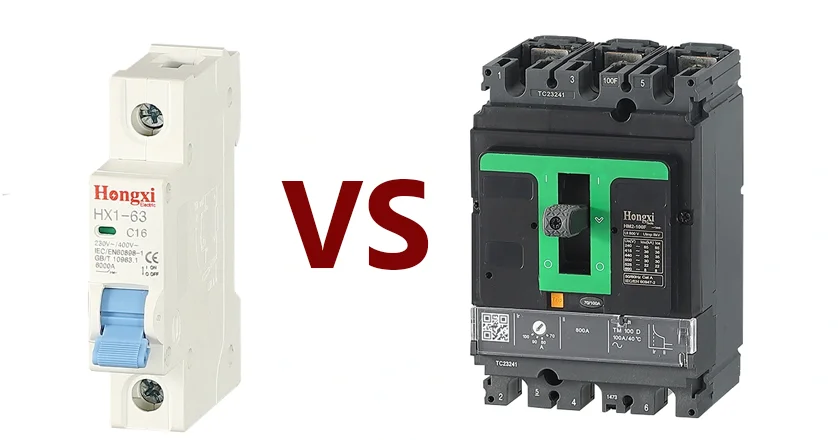
At the component level, MCBs and MCCBs differ in several critical dimensions. For a Saudi industrial factory, these differences translate directly into operational reliability.
| Parameter | MCB (Miniature Circuit Breaker) | MCCB (Molded Case Circuit Breaker) |
| Governing Standard | IEC 60898-1 | IEC 60947-2 |
| Current Range | Typically 0.5A – 125A | Typically 15A – 2500A+ |
| Voltage Rating | Up to 440V AC | Up to 1000V AC / 1500V DC |
| Breaking Capacity (ICU) | Up to 10–25kA | 10kA to 200kA |
| Trip Settings | Fixed (B/C/D curves) | Often adjustable (thermal, magnetic, electronic) |
| Physical Size | Compact (~18mm per pole) | Larger frame size increases with rating |
| Typical Application | Final circuits, lighting, and small motors | Main distribution, large motors, feeders |
| Cost | Lower | Higher |
| User Type | Unskilled | Skilled |
Breaking Capacity — A Critical Safety Parameter
In Saudi industrial facilities, available fault current can be substantial—particularly in plants located near large distribution transformers. An MCB with 10kA breaking capacity may be sufficient for a small workshop. But a large factory with a 2MVA transformer may experience fault currents of 25kA or more at the main distribution panel. In this scenario, an MCCB with 50kA or higher interrupting capacity is not optional—it is a safety requirement.
The practical implication: If a fault current exceeds the breaker's rated breaking capacity, the breaker may fail catastrophically—welding contacts, releasing ionized gas, and damaging adjacent equipment. In a Saudi industrial setting where replacement parts may take days to source, this risk is unacceptable.
Adjustability — Matching Protection to Load
MCCBs offer adjustable trip settings—thermal, magnetic, and sometimes electronic. This is invaluable for industrial applications where:
-
Motor inrush currents require delayed tripping
-
Selective coordination with downstream breakers is required
-
Future load changes are anticipated
MCBs, by contrast, have fixed trip curves. Once installed, their protection characteristics cannot be adjusted.
The Saudi Factor — Why Ambient Temperature Changes Everything
Saudi Arabia's climate is not just hot—it is extreme. Summer temperatures frequently exceed 50°C, and inside unventilated electrical rooms, temperatures can breach 60°C.
Temperature Derating — A Non-Negotiable Requirement
Every circuit breaker is calibrated at a reference temperature—typically 30°C for MCBs under IEC 60898-1. When ambient temperature rises above this reference, the breaker's current-carrying capacity decreases.
What this means for Saudi factories: A 63A MCB installed in a 50°C environment may only carry 56–58A before tripping. A 100A MCCB in the same environment may be derated to 85–90A.
| Ambient Temperature | Typical Derating Factor | Effective Capacity of 63A MCB |
| 30°C (reference) | 100% | 63A |
| 40°C | ~95% | ~60A |
| 50°C | ~90% | ~57A |
| 60°C | ~85% | ~54A |
Industry guidance for GCC conditions emphasizes that a rigorous 50°C ambient electrical design often requires reducing allowable current by 10% to 25%, depending on the application.
For industrial factories, this means:
-
Never install an MCB at its rated capacity in a hot environment—always apply derating
-
MCCBs with higher frame sizes provide more headroom for derating
-
Enclosure ventilation and separation from heat sources are critical
The 60Hz Factor
Saudi Arabia's electrical infrastructure operates at 60Hz, distinguishing it from the 50Hz standard in many other regions. While most modern MCBs and MCCBs are dual-frequency rated (50/60Hz), it is essential to verify frequency compatibility when sourcing devices.
For applications requiring both overcurrent protection and voltage stability in challenging environments, adjustable voltage and current protectors offer configurable protection that can be tuned to specific site conditions.
5 Steps to Select the Right Device for Your Saudi Factory
Follow this practical framework when specifying protection devices for industrial facilities in the Kingdom.
Step 1: Determine the Total Connected Load
Sum the expected continuous load of all downstream circuits. Include a safety margin—typically 25–30% to account for future expansion.
-
Total load ≤ 63A → MCB may be suitable (but proceed to Step 2)
-
Total load 63A – 125A → MCB may be at its limit; consider MCCB
-
Total load > 125A → MCCB is mandatory
Step 2: Calculate Available Short-Circuit Current
Determine the prospective fault current at the main panel. Factors to consider:
-
Transformer kVA and impedance
-
Cable length and size
-
Contribution from motors
-
Fault current ≤ 10kA → MCB may be sufficient
-
Fault current > 10kA → MCCB with appropriate interrupting capacity is required
Step 3: Evaluate Ambient Temperature Conditions
Measure or estimate the actual temperature inside the enclosure during the hottest months.
-
≤ 40°C → Standard derating applies; MCB may be acceptable
-
40°C – 55°C → Significant derating required; oversize or choose MCCB
-
> 55°C → Specialized high-temperature devices or forced ventilation required
Step 4: Assess Adjustability Requirements
-
Fixed protection settings acceptable → MCB may suffice
-
Motor inrush, coordination, or future load changes anticipated → MCCB with adjustable settings is preferred
Step 5: Verify SASO/SEC Compliance
-
Residential/commercial small panels → IEC 60898-1 compliant MCBs may be acceptable
-
Industrial main panels → IEC 60947-2 compliant MCCBs are typically required by SEC specifications
-
All imports → Must hold SAU IECEE certificate for customs clearance
Real-World Application Examples
Example 1: Small Workshop in Riyadh Industrial City
-
Load: 40A (lighting, small machines, office equipment)
-
Fault current: 6kA (calculated)
-
Ambient temperature: 45°C inside enclosure
-
Selection: 63A MCB with C-curve, derated to ~57A → sufficient for 40A load
-
Compliance: IEC 60898-1 certified, SAU IECEE compliant
Example 2: Medium-Sized Factory in Dammam
-
Load: 250A (multiple production lines, HVAC, conveyors)
-
Fault current: 18kA
-
Ambient temperature: 50°C inside electrical room
-
Selection: 400A frame MCCB with 50kA interrupting capacity, adjustable thermal trip set to 250A (with derating applied)
-
Compliance: IEC 60947-2 certified, SEC specification compliant, SAU IECEE certified
Example 3: Large Industrial Plant in Jubail
-
Load: 800A (heavy machinery, large motors, welding equipment)
-
Fault current: 35kA
-
Ambient temperature: 55°C in a non-air-conditioned switchroom
-
Selection: 1000A frame MCCB with 65kA interrupting capacity, electronic trip unit with adjustable settings for coordination
-
Compliance: Full SEC specification 31-SDMS-07C compliance, IEC 60947-2
Sourcing Considerations for Saudi Suppliers
For electrical distributors and procurement professionals supplying the Saudi market, several practical considerations apply:
Certification Is Non-Negotiable
Since 2021, circuit breakers entering Saudi Arabia require SAU IECEE certification. This applies to both MCBs and MCCBs. Products without proper certification will be stopped at customs.
Temperature Ratings Matter
Standard breakers rated for 40°C may not perform reliably in Saudi conditions. When sourcing, verify:
-
The device's declared operating temperature range
-
Published derating curves for temperatures above reference
-
Whether the device has been tested for 50°C+ operation
Frequency Compatibility
Saudi Arabia operates at 60Hz. While most modern devices are dual-frequency rated, always verify 50/60Hz compatibility before ordering.
Lead Times and Stock Availability
Industrial downtime in Saudi Arabia is expensive. Distributors should maintain stock of commonly used MCCB frames (100A, 250A, 400A, 630A) and MCB ratings (16A, 20A, 32A, 63A) to support rapid replacement needs.
Next Steps — From Selection Criteria to Component Specification
You now have a practical framework for deciding between MCB and MCCB for Saudi industrial applications. The key takeaways are:
-
MCBs (IEC 60898-1) are suitable for final circuits with ≤125A load and ≤10kA fault current, in environments where temperature derating is manageable
-
MCCBs (IEC 60947-2) are mandatory for main distribution panels with >125A load, >10kA fault current, or where adjustable protection settings are required
-
SASO IECEE certification is mandatory for all circuit breakers entering the Saudi market
-
Temperature derating is not optional—Saudi's 50°C+ ambient conditions require careful capacity planning
-
SEC specifications often mandate MCCBs for industrial distribution panels
Once you have determined your factory's load, fault current, and environmental conditions, comparing the specific technical specifications of available devices becomes the logical next step.
Related Reading
-
How Ambient Temperature Affects Circuit Breaker Performance