 English
 Español
You flip on the air conditioner, and suddenly the lights go out. The kitchen, the living room, and the home office all go dark. You walk to the distribution board, find a tripped breaker, reset it—and ten minutes later, it trips again. This is not just an inconvenience. It is a sign that the circuit breaker protecting that circuit may be incorrectly sized for the load it carries.
A miniature circuit breaker (MCB) is the first line of defence for your home’s electrical safety. It protects wiring and appliances from overloads and short circuits. But selecting the wrong MCB—whether too small or too large—can lead to nuisance tripping, inadequate protection, or even fire hazards.
This guide explains the key parameters you need to understand and provides a practical framework for choosing the right MCB for every circuit in your home.
What Makes a Home MCB Different from Industrial Breakers?
Before diving into selection, it helps to understand what distinguishes a residential MCB from its industrial counterparts.
Residential MCBs are typically designed and tested according to IEC 60898-1, the international standard for circuit breakers used in household and similar installations. This standard specifies that residential MCBs operate at voltages not exceeding 440V between phases, with rated currents up to 125A and breaking capacities up to 25,000A.
| Characteristic | Residential MCB | Industrial MCCB |
| Governing Standard | IEC 60898-1 | IEC 60947-2 |
| Typical Current Range | 6A – 63A | 100A – 2500A+ |
| Breaking Capacity | 4.5kA – 10kA | 25kA – 200kA |
| Trip Settings | Fixed (B/C/D curves) | Often adjustable |
| Intended User | Ordinary persons | Skilled electricians |
In practical terms, this means that for a typical home—with a main switch rated around 40A–63A and branch circuits for lighting, outlets, and appliances—MCBs are the correct and cost-effective choice. Industrial-grade MCCBs are unnecessary and oversized for residential applications.
For a detailed overview of miniature circuit breakers designed for residential and light commercial use, review the HX series residential MCBs family.
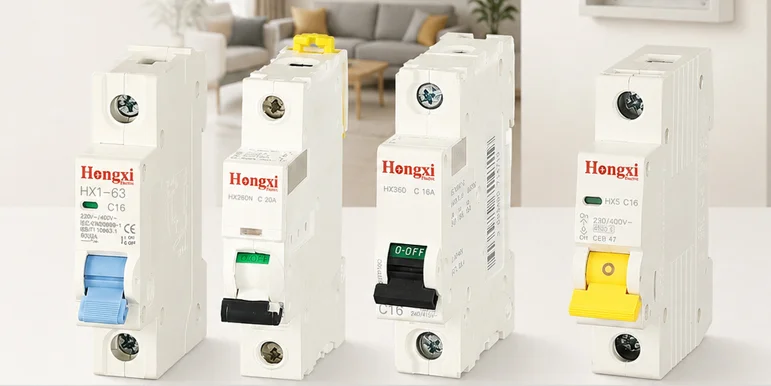
The Three Key Parameters for Selecting a Home MCB
Choosing the right MCB for a home circuit comes down to three main parameters: rated current (In), trip curve (B/C/D), and breaking capacity (Icn). Each parameter addresses a different protection need.
1. Rated Current (In) — Matching the Load
The rated current (In) is the maximum continuous current the MCB can carry without tripping. Selecting the correct In is a balancing act:
-
Too low → nuisance tripping during normal operation (e.g., when you turn on the microwave while the kettle is running)
-
Too high → the MCB may not trip during an overload, leaving wires and appliances unprotected
For residential circuits, common MCB ratings include:
| Circuit Type | Typical MCB Rating | Common Applications |
| Lighting | 6A – 10A | Ceiling lights, wall sconces, garden lighting |
| Power outlets | 16A – 20A | General sockets in living rooms, bedrooms |
| Kitchen appliances | 16A – 20A | Refrigerators, microwaves, dishwashers |
| High-power appliances | 32A | Water heaters, air conditioners, HVAC systems |
How to calculate: Add up the wattage of all devices that could run simultaneously on a circuit, divide by the voltage (230V in most regions), and add a 20–25% safety margin. For example, a circuit serving a living room with a 2000W heater and 500W of lighting and electronics would draw approximately 11A (2500W ÷ 230V). With a 20% margin, a 16A MCB would be appropriate.
2. Trip Curve — Matching the Load Type
The trip curve determines at what multiple of the rated current the MCB will trip instantaneously during a short circuit. For home use, three curves are relevant:
| Curve | Tripping Range | Best For | Why |
| Type B | 3–5 × In | Lighting circuits, general sockets, resistive loads | These loads have minimal inrush current |
| Type C | 5–10 × In | Appliances with motors (fridges, air conditioners, pumps) | Handles moderate startup surges without nuisance tripping |
| Type D | 10–20 × In | High-inrush equipment (large motors, transformers) | Rarely needed in homes; for specialised equipment |
Practical guidance for homeowners:
-
Type B is the standard choice for most household circuits. It is suitable for lighting, power outlets, and general appliances where current surges are minimal.
-
Type C is recommended for circuits serving motors or compressors—refrigerators, air conditioners, washing machines, and water pumps—to avoid nuisance tripping during startup.
-
Type D is generally unnecessary for residential applications unless you have large workshop equipment.
3. Breaking Capacity (Icn) — Handling Fault Currents
Breaking capacity (Icn) is the maximum fault current the MCB can safely interrupt without being destroyed. Residential MCBs typically offer breaking capacities of 4.5kA, 6kA, or 10kA.
| Breaking Capacity | Typical Application |
| 4.5kA | Older homes, areas far from the transformer (lower available fault current) |
| 6kA | Most modern residential installations |
| 10kA | Homes close to the transformer, or where fault current may be higher |
For a typical home, 6kA is generally sufficient. If you are unsure about the available fault current at your distribution board, consult a qualified electrician. Choosing an MCB with inadequate breaking capacity is a safety hazard—during a fault, the breaker may weld shut instead of opening.
5 Steps to Select MCBs for Your Home
Follow this step-by-step framework when planning or upgrading your home’s distribution board.
Step 1: Map Your Circuits
List every circuit in your home and what it serves:
-
Lighting circuits (usually one per floor or area)
-
Power outlet circuits (living areas, bedrooms, kitchen)
-
Dedicated circuits (air conditioner, water heater, oven, EV charger)
Step 2: Calculate the Load for Each Circuit
For each circuit, estimate the maximum simultaneous load in watts. Divide by your mains voltage (230V in most regions) to get the current in amps. Add a 20–25% safety margin.
Example: A kitchen circuit with a refrigerator (150W), microwave (1200W), and kettle (2000W) used simultaneously would draw ~14.5A. A 16A or 20A MCB would be appropriate.
Step 3: Select the Rated Current (In)
Choose the next standard MCB rating above your calculated load:
-
6A, 10A, 16A, 20A, 25A, 32A, 40A, 50A, 63A
Step 4: Choose the Trip Curve
-
Type B for lighting and general sockets
-
Type C for circuits with motors or compressors (fridge, AC, washing machine)
-
Type D only for specialised high-inrush equipment
Step 5: Verify Breaking Capacity (Icn)
Select 6kA for most modern homes. If your home is very close to the distribution transformer, consider 10kA. When in doubt, consult a qualified electrician.
Real-World Application Examples
Example 1: Lighting Circuit
-
Load: 10 LED downlights (10W each) + 2 outdoor lights (50W each) = ~200W
-
Current: 200W ÷ 230V ≈ 0.9A
-
With safety margin: ~1.2A
-
Selection: 6A Type B MCB — ample capacity, Type B for purely resistive lighting load
Example 2: Living Room Power Outlets
-
Load: TV (150W), sound system (200W), floor lamp (100W), occasional heater (2000W) = ~2450W
-
Current: 2450W ÷ 230V ≈ 10.7A
-
With safety margin: ~13.4A
-
Selection: 16A Type B MCB — Type B for general socket outlets with minimal inrush
Example 3: Refrigerator + Freezer Circuit
-
Load: Running current ~2A each, but startup surge can be 5–8× running current
-
Selection: 10A or 16A Type C MCB — Type C handles the compressor startup surge without nuisance tripping
Example 4: Air Conditioner (2.5kW)
-
Load: Running current ~11A, startup surge significantly higher
-
Selection: 20A Type C MCB — dedicated circuit, Type C for motor startup
Common Questions About Home MCB Selection
Q: Can I just use one MCB for my entire home?
No. A single MCB for the whole house means any fault—anywhere—takes down everything. Modern homes have multiple circuits: lighting, power outlets, kitchen, air conditioning, and sometimes separate circuits for each floor. This provides redundancy and makes fault finding easier.
Q: What size MCB do I need for my main switch?
The main switch (or main circuit breaker) rating depends on your total connected load and the capacity of your service connection. For a typical home, a 40A or 63A main switch is common. This should be selected by a qualified electrician based on your specific installation.
Q: Can I replace a 16A MCB with a 20A MCB if it keeps tripping?
Only if the wiring is rated for 20A. The MCB protects the wiring, not just the appliance. If you increase the MCB rating without upgrading the cable, you risk overheating the wires and causing a fire. Always match the MCB rating to the cable size.
Q: Do I need RCBOs instead of MCBs?
An RCBO combines MCB protection (overload and short circuit) with RCCB protection (earth leakage). For additional safety, many modern installations use RCBOs for socket circuits, especially in kitchens, bathrooms, and outdoor areas. This is a separate decision from MCB selection.
Next Steps — From Selection Criteria to Component Specification
You now have a practical framework for selecting MCBs for your home. The key takeaways are:
-
Match the rated current (In) to the circuit’s maximum load with a 20–25% safety margin
-
Choose the trip curve based on load type: Type B for general circuits, Type C for motor-driven appliances
-
Select adequate breaking capacity (Icn) — 6kA is sufficient for most homes
-
Never oversize an MCB beyond what the wiring can safely carry
-
Consult a qualified electrician if you are unsure about any aspect of your installation
Once you have determined the required rating, curve, and breaking capacity for each circuit in your home, comparing the specific technical specifications of available MCB families becomes the logical next step.
After establishing your home’s circuit protection requirements (current ratings, trip curves, and breaking capacity needs), you can review the technical specifications of HX series residential MCBs — including Type B and Type C options with 6kA and 10kA breaking capacities suitable for modern home installations.
Related Reading
-
RCCB vs RCBO — Which One for Your Home?
-
How to Size Cables for Home Electrical Circuits
-
Surge Protective Device Application in Solar PV Power Generation Systems
-
Understanding Electrical Load Calculation for Homes