 English
 Español
Every time a miniature circuit breaker trips and is reset, its internal contacts wear slightly. Every time it interrupts a fault current—even a low-level overload—that wear accelerates. In a busy industrial control panel with frequent motor starts, solenoid actuations, or periodic maintenance switching, a standard MCB may need replacement after just a few years. Sometimes sooner.
The cost is not just the breaker itself. It is the labor to diagnose, the downtime to replace, the inconvenience of sourcing the exact model, and the risk of improper reconnection. This guide explains how to read endurance ratings, what they mean for your panel's lifespan, and how to select MCBs that reduce replacement frequency.
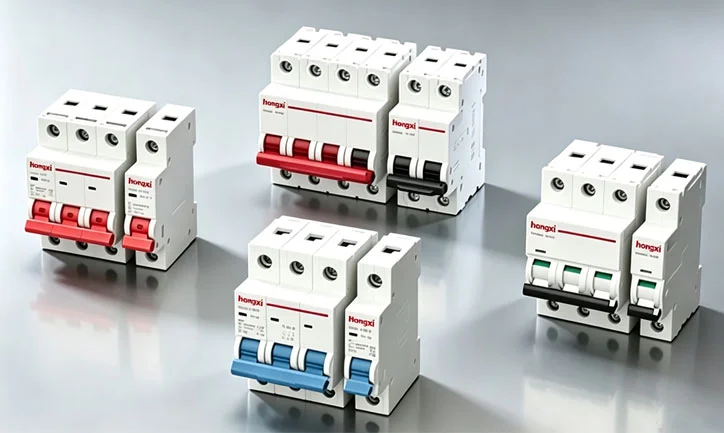
Understanding Endurance — Mechanical vs Electrical
Every MCB has two distinct endurance ratings, often printed in its technical datasheet but rarely explained to panel users.
| Endurance Type | What It Measures | What It Means for Your Panel |
|---|---|---|
| Mechanical endurance | Number of on-off operations (no current flowing) | How many times you can manually switch the breaker for isolation or maintenance before wear makes it unreliable |
| Electrical endurance | Number of on-off operations under load (rated current flowing) | How many times the breaker can be switched off under normal operating conditions before contact erosion requires replacement |
Why the distinction matters: A breaker used as an infrequent isolation switch (e.g., opened once per month for maintenance) wears mechanically but not electrically. The same breaker used to switch a motor contactor on and off dozens of times per day wears both ways—but electrical wear is usually the limiting factor.
For HX series MCBs, the mechanical endurance is rated at 10,000 operations. This is verified through type testing according to IEC/EN 60898-1 and is explicitly stated in the product technical specifications available on the Hongxi Electric website.
The practical implication: The mechanical endurance tells you how many times the breaker can be manually operated for isolation or maintenance before the mechanism wears out. For a panel that is switched off for maintenance once per month, this translates to over 800 years of service life—far exceeding any practical panel lifespan.
For detailed specifications on MCB families and their published endurance ratings, review the HX series miniature circuit breaker technical overview.
How Operation Frequency Drives Replacement Intervals
The relationship between switching frequency and MCB lifespan is linear—but only if you know which endurance rating applies to your application.
Scenario A: Infrequent Isolation Use (e.g., panel disconnect once per week)
-
Operations per year: ~50
-
Limiting factor: Mechanical endurance
-
Typical mechanical endurance rating: 10,000 operations
-
Expected life: 200 years (the breaker will outlast the panel)
Conclusion: Endurance is rarely a concern for isolation-only applications. Any standard MCB suffices.
Scenario B: Frequent Load Switching (e.g., daily motor starting)
For circuits that are switched under load on a daily basis, electrical endurance becomes the limiting factor. While the HX series datasheet provides the 10,000-operation mechanical endurance figure, electrical endurance ratings vary depending on the specific series and current rating. For applications requiring frequent load switching, users should consult the manufacturer's datasheet for the specific electrical endurance rating of the chosen model.
General guidance: For any circuit that sees daily load switching, verifying the electrical endurance rating is essential to avoid unacceptably short replacement intervals. High-endurance devices or alternative switching strategies may become necessary.
Scenario C: Mixed Use (periodic load switching plus occasional fault interruption)
Fault interruption accelerates wear dramatically. A single short-circuit interruption at the breaker's rated capacity can reduce remaining electrical endurance significantly. For panels in environments with frequent electrical faults (unstable grid, aging equipment), selecting a breaker with higher breaking capacity than strictly required provides a "wear margin" that extends life.
Factors That Accelerate MCB Wear
Even when correctly specified, MCBs can fail earlier than expected if other environmental and operational factors are not considered.
| Factor | Effect on Lifespan | Mitigation |
|---|---|---|
| Switching frequency | Each load switching operation erodes contacts | Use a contactor for frequent switching; reserve MCB for protection only |
| Ambient temperature | High temperature accelerates contact oxidation and bimetal fatigue | Apply derating factors (see temperature compensation table) or choose higher-rated breaker |
| Fault interruptions | Each fault reduces remaining endurance | Install additional upstream protection (SPD, voltage protector) to reduce fault frequency |
| Inductive loads (motors, solenoids) | Causes more severe arcing and contact erosion than resistive loads | Select MCB with appropriate breaking capacity and trip curve |
| Vibration | Mechanical wear accelerates; screws may loosen | Use lock washers, vibration-rated breakers, periodic retorquing |
Temperature derating in practice: As noted in the HX series Q&A, "at higher ambient temperatures, the MCB trips earlier; at lower temperatures, it trips later." The HX series includes a temperature compensation table showing that at 50°C, the load current should be multiplied by 0.80–0.96 to select the correct rating. In hot environments, ignoring derating not only causes nuisance tripping but also accelerates contact wear from repeated thermal cycling.
5 Steps to Match MCB Endurance to Your Panel's Duty Cycle
Follow this decision process when specifying MCBs for panels with moderate to high switching frequency.
Step 1: Estimate Annual Load Operations
Count or estimate how many times each MCB will be switched off and on under load in a typical year. Do not include infrequent isolation switching (opening the breaker with no load). Include:
-
Motor starts/stops controlled by the MCB
-
Daily equipment shutdowns
-
Periodic testing or resetting
Step 2: Identify the Limiting Endurance Type
-
If annual load operations are infrequent → mechanical endurance is usually the limit
-
If daily load switching is required → electrical endurance becomes the critical factor; consult the specific datasheet for the electrical endurance rating of the selected series
Step 3: Consider Temperature Derating
For installations in warm environments, apply the manufacturer's temperature compensation factors. For the HX series, the Q&A notes: "at 50°C, multiply your load current by 0.80–0.96 to select the correct rating." For example, if a circuit has a 16A load and operates at 50°C ambient, selecting a 20A or 25A MCB may be appropriate to account for derating.
Step 4: Check the Application Environment
-
Inductive loads (motors, solenoids) may require C or D curve MCBs to handle inrush
-
High ambient temperatures require derating
-
High fault current locations require adequate breaking capacity
Step 5: Plan for Replacement Based on Usage
Rather than waiting for failure (nuisance tripping, increased temperature, or failure to close), monitor switching frequency and consider proactive replacement when the device approaches its rated endurance.
For motor control applications where daily starting and stopping is unavoidable, motor protection circuit breakers are designed with different endurance characteristics that may better suit high-cycle applications.
Real-World Application Examples
Example 1: Conveyor System (20 starts per day)
-
Annual starts: 20 × 365 = 7,300 operations
-
Application requirement: Frequent daily switching under load
-
Recommendation: Use a contactor for switching, with the MCB serving only as backup protection. If a contactor is not feasible, select an MCB with adequate electrical endurance for the application (consult specific series datasheet).
Example 2: Standby Pump (started once per week for testing)
-
Annual starts: ~52 operations
-
Mechanical endurance: 10,000 operations
-
Calculated lifespan: 10,000 ÷ 52 ≈ 192 years
-
Recommendation: Standard MCB is more than adequate.
Example 3: Control Panel with Daily Switching
For applications requiring daily load switching, users should:
-
Consult the specific electrical endurance rating for the selected HX series model
-
Calculate expected lifespan: Electrical endurance rating ÷ Annual operations
-
Consider using a contactor for switching if the electrical endurance is insufficient
The Special Case of Temperature Derating
As documented in the HX series Q&A, temperature significantly affects MCB performance:
-
At higher ambient temperatures, the MCB trips earlier
-
At lower ambient temperatures, it trips later
Practical implication: For installations in warm environments (electrical rooms, outdoor enclosures in hot climates), the effective current-carrying capacity is reduced. The HX series datasheet provides a temperature compensation table. For example, at 50°C ambient, the load current should be multiplied by 0.80–0.96 to determine the correct MCB rating.
Next Steps — From Endurance Needs to Component Selection
You now have a practical framework for evaluating whether standard MCBs will meet your panel's lifespan requirements. The key takeaways are:
-
Mechanical endurance (10,000 operations for HX series) covers manual switching without load and is rarely a practical limit
-
Electrical endurance is the critical factor for circuits that are switched under load regularly—consult the specific datasheet
-
Temperature derating is essential in hot environments—refer to the HX series compensation table
-
For frequent switching, consider using a contactor for the switching function and the MCB for protection only
Once you have determined the required endurance class for each position in your panel, comparing the specific technical data of available families becomes the logical next step.
Related Reading
-
How Ambient Temperature Affects Circuit Breaker Performance
-
Contactor vs MCB for Motor Control Applications