 English
 Español
A panel builder in Nairobi recently lost a tender for a commercial tower project. Their proposal met all the load calculations. The enclosure quality was excellent. The pricing was competitive. So what went wrong? The consulting engineer rejected the bid because the MCB specification showed 1P breakers on distributed neutral circuits where local code required 1P+N.
The difference between winning and losing a project can come down to understanding pole configurations. Not because it is complicated. But because getting it wrong signals inexperience.
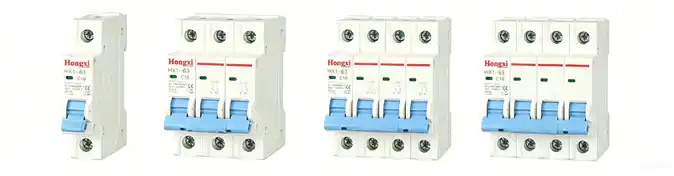
For panel builders and electrical engineers, selecting the correct number of poles is not just about making the circuit work. It affects compliance with wiring regulations, coordination with upstream protection, physical space inside the enclosure, and ultimately the total project cost.
Let us break down each configuration by its technical characteristics, typical applications, and the trade-offs you need to consider during specification.
The Fundamental Difference: What Does Each Pole Actually Do?
Every pole in a miniature circuit breaker interrupts one current-carrying conductor. A 1P breaker switches one line. A 2P switches two lines (typically line and neutral, or two lines in a split-phase system). A 3P switches three phases. A 4P switches three phases plus neutral.
But the behavior of the neutral pole varies significantly between manufacturers and product families. Some 1P+N devices switch only the line and keep the neutral continuous. Others (marked as 2P) switch both simultaneously with identical trip characteristics. This distinction matters more than most spec sheets acknowledge.
| Configuration | Switched Conductors | Typical Application | Neutral Behavior |
|---|---|---|---|
| 1P | Single phase (line only) | Lighting, general outlets | Neutral unswitched |
| 1P+N | Phase + neutral | Residential distribution boards | Neutral switched, but often without overload protection |
| 2P | Two lines (phase + neutral) | Single-phase with full isolation | Both poles protect against overload and short circuit |
| 3P | Three phases (L1, L2, L3) | Three-phase motors, pumps, heaters | No neutral involved |
| 4P | Three phases + neutral | Three-phase + neutral systems | Neutral switched; may or may not include neutral overload protection |
Detailed Breakdown by Configuration
1P (Single Pole)
How it works: The breaker connects in series with the live conductor only. The neutral runs directly from the incoming supply to the load without interruption.
Best for: Lighting circuits, general purpose socket outlets, fixed equipment with no requirement for full isolation.
Advantages: Smallest width (typically 17.5mm per pole). Lowest cost per circuit. Widely available.
Limitations: Does not isolate the neutral. If the neutral becomes live due to a fault elsewhere in the installation, the circuit remains hazardous even with the breaker off.
Compliance note: Permitted in TN systems where the neutral is reliably at earth potential. Not permitted in TT systems without additional RCD protection upstream.
2P (Double Pole)
How it works: Both line and neutral conductors have their own protective mechanisms. Both trips simultaneously on overload or short circuit.
Best for: Single-phase circuits requiring complete isolation. Backup generator feeds. Circuits supplying equipment with high leakage current.
Advantages: Provides full disconnection. Safer for maintenance. Required in some international standards (IEC 60364) for socket outlets above 20A.
Limitations: Requires more panel space than 1P (typically 35mm). Higher component cost.
3P (Three Pole)
How it works: Switches and protects all three phases simultaneously. Does not interact with the neutral conductor.
Best for: Three-phase motors, compressors, industrial heaters, rectifiers, any three-phase load that does not require a neutral.
Advantages: Standard configuration for industrial motor control. Compatible with most three-phase contactors and overload relays.
Limitations: Not suitable for circuits that distribute single-phase loads derived from a three-phase system.
Critical note: Never use three separate 1P breakers as a substitute for a 3P breaker on a three-phase motor. The internal trip mechanism of a 3P unit ensures all phases disconnect simultaneously. Three singles do not guarantee this.
4P (Four Pole)
How it works: Switches and protects three phases and the neutral conductor. In most designs, the neutral pole has an instantaneous trip characteristic (no overload delay) to ensure neutral disconnection under any fault.
Best for: Changeover switches, generator mains panels, TN-C-S systems where the neutral must be isolated, circuits supplying sensitive electronic loads.
Advantages: Complete isolation of the entire circuit. Required for automatic transfer switching applications.
Limitations: Most expensive. Largest panel footprint (70mm minimum). Potential for nuisance tripping if neutral harmonics are present.
Compliance warning: International standard IEC 60364-4-46 states that the neutral conductor should not be interrupted unless necessary. Do not specify 4P breakers by default.
Selection Decision Matrix for Common Scenarios
| Application Scenario | Recommended Configuration | Why |
|---|---|---|
| Lighting circuit, office building, TN-S system | 1P | Neutral remains continuous; lower cost |
| Socket outlet circuit, any system | 1P or 1P+N | RCD protection is typically provided separately |
| Single-phase backup generator feed | 2P | Complete isolation is required during the changeover |
| Three-phase conveyor motor, no neutral | 3P | Simultaneous three-phase disconnection |
| Three-phase distribution panel with line-to-neutral loads | 3P | Neutral remains continuous on main breaker; individual 1P breakers for each single-phase circuit |
| Main switch for TT system | 4P (or 2P for single-phase) | Neutral must be isolated to meet earth fault requirements |
| Automatic transfer switch (ATS) | 4P | Prevents circulating neutral currents between sources |
Cost and Space Trade-offs
For panel builders standardizing a product line, the difference between 1P and 4P specifications affects two measurable variables:
Panel width: A 12-circuit single-phase distribution board using 1P breakers requires approximately 210mm of DIN rail space. The same board using 2P breakers requires 420mm—double the enclosure width.
Component cost per pole: In typical wholesale pricing, a 4P breaker costs three to four times more than a 1P breaker from the same series. Specifying 4P where 3P or 1P would suffice directly erodes margin on fixed-price bids.
For teams regularly configuring panels for mixed commercial and industrial projects, reference specifications for modular protection components can help standardize selections across multiple job types.

Common Specification Mistakes to Avoid
Mistake 1: Assuming "more poles = better safety"
A 4P breaker on a three-phase motor circuit (where no neutral exists) wastes space and money but does not improve safety. The unused neutral terminal sits empty, creating a potential entry point for contaminants.
Mistake 2: Mixing pole configurations within a single panel without labeling
When some circuits use 1P and others use 1P+N or 2P, maintenance electricians cannot assume the neutral is continuous. Unlabeled mixed configurations lead to incorrect isolation during live work.
Mistake 3: Ignoring the manufacturer's neutral pole rating
On some 4P breakers, the neutral pole has a lower current rating than the phase poles. Installing such a breaker on a circuit where neutral carries harmonic currents (from VFDs or LED lighting) can cause unexpected neutral overload tripping.
Decision Workflow for Your Next Specification
When specifying MCBs for an upcoming project, run this sequence:
-
Identify the supply system – TN, TT, or IT? Single-phase or three-phase?
-
Determine if neutral requires switching – Refer to local wiring regulations (SANS 10142, IEC 60364, NEC)
-
Count the live conductors that need simultaneous disconnection – That number equals the minimum pole count
-
Add poles only if required by a specific application – Changeover switches, isolation for maintenance, or generator feeds
Following this workflow typically results in 1P or 3P for most general circuits, with 2P and 4P reserved for specific isolation or changeover requirements.
When to Deepen Your Technical Reference
For engineering firms that specify MCBs across multiple projects, maintaining a standardized component library reduces specification errors and simplifies procurement review. A well-organized technical reference for DIN-rail protection devices allows design teams to verify pole configurations, trip characteristics, and terminal compatibility without searching through disconnected supplier datasheets.
Summary: Matching Poles to Purpose
| If you need… | Specify… |
|---|---|
| Basic overload and short-circuit protection for lighting | 1P |
| Complete isolation of a single-phase circuit | 2P |
| Three-phase motor or heater protection | 3P |
| Neutral switching for generator changeover or TT systems | 4P |
| Compliance with unspecified local codes | 1P+N (the safest default for residential/commercial) |
The right pole configuration is not about choosing the most expensive option or the cheapest. It is about matching the breaker's behavior to the circuit's electrical characteristics and the maintenance requirements of the installation.
Before your next panel leaves the workshop, have you verified that every breaker's pole count matches both the supply system and the load's neutral requirement? That five-minute check prevents field callbacks that cost far more than the components themselves.