A manufacturing facility installs a new conveyor system. The panel builder selects a 16A miniature circuit breaker to both protect and switch the motor. It works—for about three months. Then the breaker starts tripping intermittently. Then it fails to reset. The cause is not a faulty product; it is a fundamental mismatch between device design and application duty.
Motor circuits present a unique challenge: they require overload and short-circuit protection plus frequent switching (starting and stopping). Many specifiers assume one device can do both. But contactors and MCBs are engineered for fundamentally different purposes.
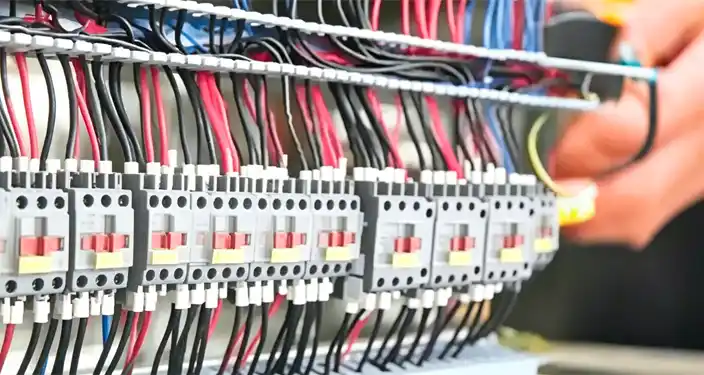
This guide explains the distinction, shows you how to match device types to your application, and helps you avoid premature failures caused by using the wrong component for the job.
The Fundamental Difference – Switching vs Protection
At the most basic level, contactors and MCBs serve different roles in a motor control circuit.
| Device | Primary Function | Design Priority | Typical Lifespan (Electrical) |
|---|---|---|---|
| Contactor | Frequent load switching | Arc quenching, contact durability | 500,000–1,000,000+ operations |
| MCB | Overcurrent protection | Accurate tripping, fault interruption | 1,500–10,000 operations |
Why the difference matters: A contactor is designed to open and close under load thousands or millions of times. Its contacts are shaped and sized to handle arcing from inductive motor currents. An MCB, by contrast, is designed to sit closed for years and open only occasionally—either manually for isolation or automatically during a fault. When an MCB is used for daily motor starting, its contacts erode rapidly.
The governing standard for contactors, IEC 60947-4-1 (Low-voltage switchgear and controlgear – Contactors and motor-starters), requires endurance testing under AC-3 and AC-4 duty cycles that simulate frequent motor starting and inching. These test protocols—which involve thousands of operations at rated current—reflect the real-world demands of motor control. Standard MCBs, tested under IEC 60898 or IEC 60947-2, are not subjected to the same endurance requirements.
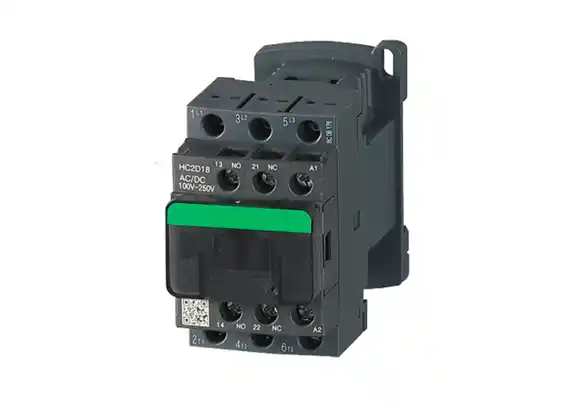
For technical specifications on AC contactors designed specifically for motor control duty cycles, review the HC series AC contactor family, including published electrical endurance ratings for AC-3 and AC-4 applications.
When to Use Each Device – A Decision Framework
Use a Contactor When…
| Application Characteristic | Why a Contactor Is Required |
|---|---|
| Daily motor starts/stops (10+ per day) | Contactors are tested for millions of electrical operations |
| Remote or automated control | Contactors accept low-power control signals (e.g., 24V DC, 110V AC) |
| Motor reversing or inching (plugging) | AC-4 duty requires robust arc quenching |
| Any motor above 1kW that starts more than once per shift | Inductive inrush accelerates MCB contact wear |
Use an MCB Alone When…
| Application Characteristic | Why an MCB Suffices |
|---|---|
| Motor starts infrequently (less than once per week) | Electrical endurance is not exhausted within panel life |
| The MCB serves only as backup protection (not primary switching) | A separate contactor handles load switching |
| Small motor (<500W) started less than once per day | Wear may still be acceptable over 5–10 years |
| Manual isolation and fault protection only | No load switching required |
The Most Common Configuration: Contactor + MCB (or MPCB)
For the vast majority of industrial motor control applications, the correct solution is not either/or—it is both. A contactor performs the frequent load switching. An MCB or motor protection circuit breaker (MPCB) provides backup overcurrent protection and isolation.
In this arrangement, the contactor opens and closes the motor circuit for normal starting and stopping. The MCB remains closed during normal operation, opening only during a fault (short-circuit or prolonged overload) or when manually opened for maintenance. This separates the endurance demand (handled by the contactor) from the protection function (handled by the MCB).
For applications requiring both protection and frequent switching in a compact form factor, motor protection circuit breakers combine adjustable overload protection with isolation capability and are often paired with contactors in starter assemblies.
5 Steps to Specify the Right Combination for Your Motor
Follow this decision sequence when designing a motor control circuit.
Step 1: Determine Your Required Switching Frequency
-
Less than 5 starts per day → An MCB alone may work for very small motors (<1kW), but a contactor is still better practice
-
5–20 starts per day → Contactor required; MCB provides backup protection only
-
More than 20 starts per day → Contactor mandatory; consider AC-4 rated contactor for demanding cycles
Step 2: Select Your Contactor by Motor Power
Match the contactor’s AC-3 rated current to your motor’s full load current (FLC). Do not use the contactor’s thermal current rating (Ith), which is typically higher.
| Motor Power at 400V | Approximate FLC | Minimum Contactor AC-3 Rating |
|---|---|---|
| 0.75 kW (1 HP) | 2.2 A | 9 A |
| 2.2 kW (3 HP) | 5.5 A | 9 A |
| 5.5 kW (7.5 HP) | 12 A | 12 A |
| 11 kW (15 HP) | 22 A | 25 A |
| 22 kW (30 HP) | 44 A | 50 A |
Step 3: Select Your Backup Protection (MCB or MPCB)
The protection device should be sized to:
-
Carry normal motor running current without nuisance tripping (typically 1.5–2.5× FLC for thermal protection)
-
Withstand motor starting inrush (typically 6–8× FLC for 0.5–2 seconds)
-
Trip on sustained overloads (above 1.2× FLC for extended periods)
-
Interrupt short-circuit currents without welding contacts
A C-curve MCB (5–10× In magnetic trip) is generally appropriate for motor branch protection. For larger motors or higher starting currents, a D-curve MCB (10–20× In) may be required to avoid nuisance tripping during start-up.
Step 4: Consider a Motor Protection Circuit Breaker (MPCB) as an Integrated Alternative
MPCBs combine adjustable thermal overload protection (which can be set exactly to motor FLC) and magnetic short-circuit protection in a single device. They are designed specifically for motor circuits and offer advantages over MCB+contactor combinations:
-
Adjustable current range – Dial matches motor nameplate FLC exactly
-
Phase failure protection – Detects single-phasing conditions that can burn out motors
-
Compact footprint – Saves panel space compared to separate devices
When using an MPCB, you still need a contactor for frequent switching. The MPCB provides protection; the contactor provides switching.
Step 5: Verify Coordination Between Contactor and Protection Device
Ensure that:
-
The protection device (MCB or MPCB) does not trip during normal contactor switching
-
The contactor’s breaking capacity exceeds the maximum possible fault current at its location (otherwise, a downstream short circuit could weld the contactor closed)
-
For critical applications, selective coordination between upstream and downstream devices is documented
Real-World Application Examples
Example 1: Conveyor System (20 starts per hour, 8 hours per day)
-
Annual starts: 20 × 8 × 250 = 40,000 operations
-
Standard MCB electrical endurance: ~4,000 operations (fails in 7 weeks)
-
Contactor electrical endurance (AC-3): 1,000,000+ operations (lasts 25+ years)
-
Correct configuration: 12A contactor (switching) + 16A C-curve MCB (protection)
Example 2: Standby Pump (started once per week for test, automatically during power failure)
-
Annual starts: ~60 operations (including tests and actual events)
-
Standard MCB electrical endurance: 4,000 operations (far exceeds needs)
-
Contactors add cost and complexity without benefit
-
Correct configuration: MCB alone, sized appropriately, or manual motor starter for local control
Example 3: Crane Hoist with Frequent Reversing (inching duty)
-
Operating mode: Multiple reversals per minute during positioning
-
AC-4 duty (starting, plugging, inching) – extremely demanding on contacts
-
Standard AC-3 contactor would wear rapidly
-
Correct configuration: AC-4 rated contactor (often larger frame size or derated) + MPCB for protection
Common Misconceptions About MCBs in Motor Circuits
| Misconception | Reality |
|---|---|
| “MCBs are rated for 10,000 electrical operations, so they can switch motors daily.” | The 10,000 figure is often mechanical endurance (no load). Electrical endurance at motor starting currents may be 1,000–4,000 operations. |
| “A D-curve MCB protects my motor from burnout.” | D-curve only delays magnetic tripping. It does not provide adjustable thermal protection matched to motor FLC. |
| “Using a contactor adds unnecessary cost.” | Replacing a failed MCB every 2–6 months costs more in downtime and labor than a contactor that lasts 20 years. |
| “An MPCB replaces a contactor.” | No. An MPCB provides protection, not frequent switching. Both are still required for automated motor control. |
Industry guidance from the National Electrical Manufacturers Association (NEMA) in ICS 2-2022 (Industrial Control and Systems Contactors, Controllers, and Manual Starters) clarifies that contactors and motor overload relays are designed as a coordinated system, while circuit breakers alone do not provide the thermal memory and phase-loss detection needed for comprehensive motor protection.
Next Steps – From Application Requirements to Component Selection
You now have a clear decision framework for motor control circuits:
-
Use a contactor for any motor that starts daily (or more frequently)
-
Use an MCB or MPCB for backup protection, not primary switching
-
For very infrequent starts, an MCB alone may be acceptable for small motors
-
When in doubt, specify a contactor – the cost is small compared to the downtime of premature MCB failure
The correct configuration is almost never “contactor OR MCB” but rather “contactor AND protection device (MCB/MPCB).”
Once you have determined your motor’s starting frequency, power rating, and duty cycle (AC-3 vs AC-4), comparing the specific ratings of available contactors and protection devices becomes the logical next step.
After establishing your motor control requirements (switching frequency, motor power, and duty cycle), you can review the AC contactor ratings for HC series devices—including AC-3 and AC-4 electrical endurance values—and examine HGV2 series motor protection circuit breakers for coordinated backup protection.
Related Reading
-
Reduce Replacement Frequency with High-Endurance MCB
-
Motor Protection Circuit Breaker vs Thermal Overload Relay + Contactor
-
Understanding AC-3 and AC-4 Duty Cycles
-
How to Size Branch Circuit Protection for Motors